
Middle-America's most engaging authors since 1998.
Middle-America's most engaging authors since 1998.
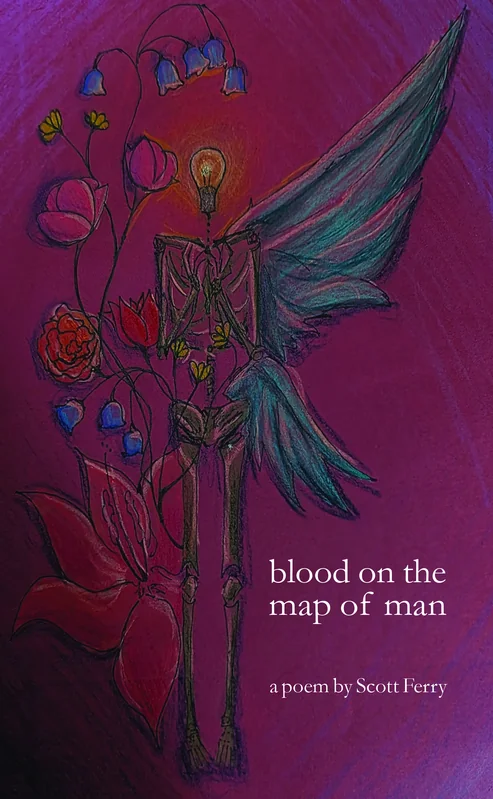
In Blood on the Map of Man, Scott Ferry offers an extended meditation that is at once intimate, philosophical, and profoundly ecological. This book-length poem transforms the ordinary—parenting, illness, yard work, grief—into a luminous field of inquiry where the personal and the universal continually intertwine. Ferry’s voice is precise yet fluid, attentive to both lyric image and ethical weight. Domestic moments become sites of metaphysical resonance: a child’s Lego dinosaur embodies evolutionary imagination, a dermatologist’s cauterization echoes mortality’s inscription on the flesh, a daughter’s lament for “a human body” gestures toward exile from the numinous.
What makes this sequence extraordinary is its patience and scope. Each section accrues like a meditation bead, building a work that resists despair by locating fragile moments of grace: a father laughing with his children, the shimmer of river light, the possibility of solidarity even against mortality. blood on the map of man is an ambitious and luminous contribution to contemporary poetry—a sustained act of witness reminding us of the porous boundary between loss and wonder.
I recommend this book to every reader of poetry, but especially to those with families, who will recognize in its pages the profound beauty, vulnerability, and transcendence found in the daily fabric of love.
—Rick Christiansen, author of Not a Hero
Scott Ferry’s long lyric poem, Blood on the Map of Man, is as spare as it is muscular—using, for the most part, line and stanza breaks to guide the reader rather than punctuation. We are introduced to the young son and daughter—the light and the darkness of them both. when my daughter feels good about herself /she radiates a sad sweetness—my son’s darkness is unintentional/and mine is merely a function of lost magic. The poem enters the sudden precarity of our finite lives—i don't trust the sky to/hold—and then veers away again, only to return. Deftly described dreams of the poet, of the son and the daughter appear throughout the poem. And everywhere, the poet holds himself to the highest standards. The highest standards of a poet—i haven’t written about my heart—and the highest standards of humanity— i weep sometimes that i cannot be/all that i want to be for god. Scott Ferry has given us a tender, worthwhile read.
—Donna Spruijt-Metz, author of To Phrase a Prayer for Peace
William Carlos Williams states, “memory is a kind / of accomplishment / a sort of renewal,” and Scott Ferry’s most recent chapbook, blood on the map of man, is comprised of poems on the edges of dreams and reality—how memories try to heal the past. Ferry’s journey through memories with his family is one that we cannot, will not forget. These simultaneously lyrical and narrative poems take us through all the emotions of parenthood—from contemplating our own existence, to laughing with a toddler son, to crying silently in the pain of the daughter’s womanhood and asthma. These beautifully constructed “poems which are more like prayers” remind us to appreciate our short lives, the experiences that turn to memories—our “dramas and blood”—which “are starflakes.”
—Liz Marlow, author of the chapbook, They Become Stars, editor of Minyan Magazine
Scott Ferry’s newest collection blends care and worry as Ferry raises each poem with the patience and tenderness with which he raises his children. blood on the map of man thrives under the same truth and sunlight Ferry shines on the garden in Winter. These words were developed in darkness, but each Scott Ferry poem is worth a thousand photographs.
—Shawnte Orion, author of The Existential Cookbook (NYQ Books)